
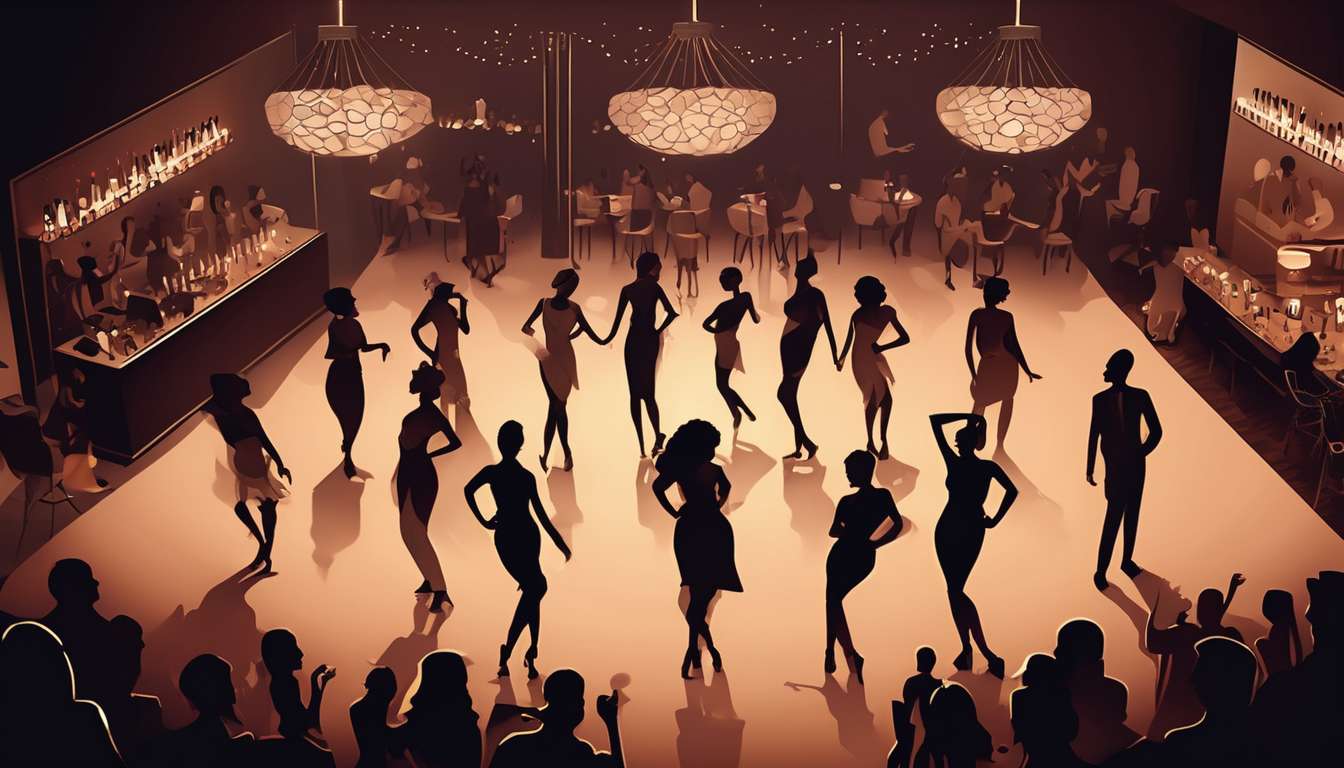
Starting image and thesis
Starting with the steady hum of neon and the quiet click of high heels, we contrast the traditional image of exotic dance venues with the sophisticated service ecosystems they increasingly resemble.
Audiences are diverse
We recognize that audiences are not a monolith:
- Some seek escapism.
- Others seek cultural connection.
- Many prioritize safety and discretion.
Design choices respond to demographics
By juxtaposing rowdy nightclub expectations against curated lounge experiences, we show how demographics—age, gender identity, income, cultural background—shape design choices from:
- Lighting and sound
- Booking flows
- Staff training
Goal: bridge perception and practice
We aim to translate audience insight into actionable service design strategies that respect performers and patrons alike.
Methods and deliverables
Together, we will:
- Map user journeys.
- Identify decision drivers.
- Recommend inclusive touchpoints that enhance satisfaction and sustainability.
Reframing the industry
This guide reframes exotic dancing as a service industry requiring empathy, research, and deliberate design, not just ambiance, offering a pathway for venues to evolve responsibly and profitably.
Understanding Audience Segments
We’ll break the audience into distinct segments based on demographics, motivations, and behavior to design services that actually meet their needs.
We’ll identify clusters by shared values and habits so everyone feels known and welcome.
- Use audience segmentation to map:
- who’s motivated by social connection,
- who seeks performance/novelty, and
- who prioritizes discretion.
We’ll track patron spending behavior to tailor pricing tiers, promotions, and loyalty perks.
- Design incentives that:
- reward regulars, and
- invite newcomers with approachable entry points.
We’ll document safety and privacy expectations for each segment, aligning staff training, venue layout, and communication.
- Outcomes include:
- staff trained to meet specific boundary needs,
- physical layout that supports comfort and privacy, and
- messaging that reassures guests their boundaries matter.
By combining clear profiles with modest personalization, we’ll create experiences that foster belonging without stereotyping.
- Prioritize measurable signals:
- Visit frequency
- Spend per visit
- Stated preferences
We’ll iterate offerings responsively using those signals to build a service framework that balances warmth, professionalism, and practical safeguards.
The result: guests recognize themselves in what we offer and feel confident returning.
Age and Life Stage Effects
Different age groups and life stages shape motivations, availability, and comfort levels.
We’ll tailor service elements—pricing, programming, and privacy options—to match those evolving needs.
Audience segmentation will identify cohorts:
- Younger patrons seeking social energy.
- Mid-life guests balancing work and family schedules.
- Older attendees valuing relaxed pacing and familiarity.
For each cohort we’ll map spending behavior and design inclusive offers:
- Nightlife packages and student nights for younger patrons.
- Midweek loyalty perks for busy professionals.
- Daytime community events for retirees.
We’ll respect safety and privacy expectations across stages.
- Discreet entrances.
- Clear consent policies.
- Varied seating arrangements to increase comfort.
Communications will match tone and channels appropriate to life stage, fostering belonging rather than exclusion.
By aligning programming, pricing, and venue norms to these segments, we’ll create experiences that meet real needs, encourage repeat visits, and build a welcoming community where every patron feels understood and respected.
Gender and Identity Dynamics
We’ll design services that recognize how gender identities and expressions shape comfort, interaction preferences, and expectations within the venue.
We’ll map audience segmentation beyond binaries, acknowledging queer, trans, nonbinary, and cis patrons so everyone feels seen.
By creating clear communication about spaces, dress codes, and performer choice, we foster belonging while reducing uncertainty.
We’ll align service points—host seating, private rooms, and signage—with diverse needs, and train staff to respond respectfully to pronouns and presentation.
That clarity supports patron spending behavior patterns linked to repeat visits and word-of-mouth trust, because people return where they feel affirmed.
We’ll embed safety and privacy expectations into booking, entrance procedures, and digital touchpoints, making confidentiality and consent explicit.
We’ll establish regular feedback loops to refine categories and offer tailored experiences without stereotyping.
Overall, our approach centers dignity: designing around varied gender identities encourages inclusive interactions, dependable safety practices, and community-driven improvements that strengthen long-term engagement.
Income and Spending Patterns
We’ll analyze how income levels, discretionary budgets, and payment preferences shape visit frequency, tipping, package choices, and upsell receptivity.
Segment patrons by income to inform audience segmentation and tailor offers that feel respectful and inclusive.
- Lower-discretion visitors often favor clear value: happy-hour pricing, bundled services, and transparent cover fees.
- Higher-income patrons gravitate toward premium packages, private experiences, and quicker acceptance of upsells.
Track patron spending behavior to predict visit cadence and design loyalty tiers that reward regulars without alienating newcomers.
- Create tiered benefits that scale access and perks rather than gate essential value.
- Use spend-based triggers (visit frequency, average ticket, upsell conversion) to automate personalized offers.
Align payment options with safety and privacy expectations so patrons feel secure when transacting.
- Support cash, card, and discreet digital methods.
- Use clear signage about payment and tipping norms to build trust and reduce friction.
Involve staff in interpreting spend signals and adapting pitch tactics, balancing revenue goals with genuine hospitality.
- Train staff to read behavioral cues and offer appropriate upsells without pressure.
- Collect frontline feedback to refine segmentation and offers.
Connect fiscal choices to belonging to create environments where patrons of varied means feel seen, respected, and encouraged to return.
- Ensure messaging emphasizes choice and dignity.
- Regularly review offers and experiences to prevent exclusionary practices and maintain inclusivity.
Cultural and Ethnic Considerations
We will intentionally design experiences and communication that respect the cultural backgrounds, traditions, and sensitivities of diverse dancers and patrons.
We recognize cultural and ethnic differences influence how people identify, celebrate, and seek connection, so we use audience segmentation to avoid one-size-fits-all approaches.
By mapping cultural preferences to programming, music, dress codes, and holidays, we create spaces where everyone feels seen and valued.
We will gather qualitative input from community representatives and dancers to refine offerings.
We will monitor patron spending behavior to ensure pricing, promotions, and product mixes align with varied expectations without stereotyping.
We will craft inclusive signage, imagery, and language that reflect the communities we serve and promote staff training in cultural competence to reduce microaggressions.
We will balance representation across marketing channels and performance rosters so patrons and performers can find belonging.
We will document policies that honor cultural expression while maintaining equitable access.
In doing so, we will build trust, improve retention, and sustain a respectful environment for all participants.
Safety and Privacy Expectations
We will establish clear safety and privacy standards that protect dancers, staff, and patrons while enabling enjoyable, confidential experiences.
We recognize that belonging grows from trust, so we set protocols reflecting audience segmentation and patron spending behavior to match diverse needs.
We will train teams on de-escalation, incident reporting, and discreet handling of disputes so everyone feels respected and secure.
We will implement practical measures that align with stated safety & privacy expectations without isolating patrons or performers:
- Controlled access (entry checks, credentialing for staff/backstage)
- Well-lit backstage paths and public areas
- Privacy screens and designated private spaces
- Secure payment options (tokenization, EMV, discreet receipts)
We will communicate policies transparently and invite feedback from regulars and newcomers alike.
- Use segmented insights to tailor messaging and operational rhythms
- Provide clear signage, digital policy summaries, and staff briefings
- Offer confidential channels for reporting concerns and suggestions
We will monitor patterns in patron spending behavior to identify risks and opportunities and adjust operations accordingly.
- Analyze anonymized spending and attendance patterns to inform staffing and supervision levels.
- Use insights to schedule peak coverage and targeted interventions without singling out individuals.
We will protect personal data with clear retention limits and consent-driven practices.
- Collect only necessary information and document lawful purpose.
- Implement retention schedules and secure deletion.
- Obtain and record consent for any use beyond core operational needs.
By centering safety and privacy in design choices, we will foster an inclusive environment where community members feel seen, protected, and free to engage on their own terms.
Service Touchpoints and Design
We’ll map every guest interaction—from first discovery to post-visit follow-up—and design each touchpoint to be seamless, respectful, and aligned with our safety, privacy, and accessibility standards.
We’ll craft entrance, seating, performance, payment, and exit flows that acknowledge varied audience segmentation and make every person feel seen.
- Signage, staff greetings, and digital booking should reflect inclusive language and clear options so patrons know what to expect.
We’ll calibrate service pacing and amenities based on patron spending behavior, offering tiered experiences that respect comfort levels without pressure.
- Tiered experiences should be optional, clearly described, and avoid coercive upselling.
- Amenities and pacing are adjusted to match comfort and accessibility needs.
Staff training will focus on reading cues, de-escalation, and honoring boundaries so interactions feel consensual and dignified.
- Training topics:
- Observational cue recognition.
- Verbal and non-verbal de-escalation techniques.
- Boundary-respecting interaction protocols.
Payment and data capture will minimize exposure and meet articulated safety & privacy expectations, using discreet transactions and clear consent for any marketing.
- Use minimized data collection, secure processing, and opt-in consent flows.
- Provide clear signage and staff scripts about what data is collected and why.
We’ll close the loop with targeted follow-ups that invite feedback, celebrate belonging, and adapt touchpoints continuously.
- Follow-up mechanisms:
- Segmented, consented feedback requests.
- Personalized acknowledgements that reinforce belonging.
- Regular review cycles to iterate on touchpoint design.
Every design choice will center dignity, transparency, and the relationships we build with our guests.
Translating Insights into Policy
We’ll convert our research and touchpoint learnings into clear, enforceable policies that mandate respectful conduct, privacy safeguards, accessibility measures, and escalation procedures.
We’ll define rules that reflect audience segmentation insights so each patron cohort feels seen and protected, and we’ll tie expectations to measurable behaviors.
We’ll specify staff protocols for responding to varied patron spending behavior, ensuring service levels match expressed preferences without privileging harassment or exclusion.
We’ll articulate safety & privacy expectations explicitly:
- What data we collect.
- How we store it.
- Who can access it.
- How consent is obtained.
We’ll build accessible entry points and accommodations into policy, not as optional extras but as required standards.
We’ll train teams on de-escalation and reporting, create transparent complaint processes, and set accountability metrics reviewed regularly.
We’ll publish two versions of the policy:
- Concise summaries for patrons.
- Detailed internal guides for staff.
We’ll foster trust and belonging by showing that our policies reflect lived experiences and protect everyone in our space.
How do legal restrictions and zoning laws uniquely shape venue design and service offerings for exotic dancing beyond what’s covered under policy translation?
Legal restrictions and zoning laws uniquely shape venue design and service offerings for exotic dancing in ways that go beyond simple policy translation.
Setback and opacity rules change entryways and sightlines.
- These rules may require windows to be opaque or customer areas to be set back from public sidewalks, which forces designers to rethink how patrons first approach and experience the space.
- As a result, venues often move lobbies inside, create enclosed vestibules, or design controlled sightlines so private performances remain compliant while still providing an engaging arrival experience.
Licensing, permitted activities, and hours alter staffing and programming.
- Licensing conditions commonly specify allowed activities, performer-to-patron ratios, and operating hours.
- This creates operational constraints that influence shift scheduling, entertainment lineups, cover policies, and whether food or alcohol service can be combined with performances.
- Venues adapt by creating modular programming blocks, staggered staff schedules, and dual-use service models (for example, daytime food service and evening performance programming) that remain within license conditions.
Safety regulations dictate lighting, barriers, and egress.
- Fire, building, and occupational-safety codes require specific egress widths, illuminated exit paths, and unobstructed stairways, which shape floor plans and circulation.
- Safety rules often mandate barriers, guardrails, or minimum separation between performers and patrons in certain areas, affecting stage design and seating layouts.
- Venues reconcile safety compliance with customer experience by integrating protective elements as design features (lighting, materials, and furniture that feel intentional rather than restrictive) and by locating performance areas to preserve visibility while maintaining required separations.
Zoning limits location, parking, and nearby uses.
- Zoning ordinances commonly restrict where exotic-dancing venues can locate (buffer distances from schools, churches, residential zones), limit hours of operation, or impose parking minimums.
- These constraints influence site selection, building orientation, and whether on-site parking, valet, or transit-access investments are needed.
- When zoning reduces nearby complementary uses (restaurants, late-night transit), venues may adapt by offering additional on-site services (food, coat check, ride coordination) to make the location viable.
Site-specific compliance leads to tailored layouts and service offerings that include staff and patrons.
- Rather than one-size-fits-all fixes, venues adopt context-driven design responses: enclosed entries where street-facing windows are restricted, raised stages with compliant barriers where separation is required, or flexible seating that can be reconfigured to meet different permit conditions.
- Service offerings are adjusted to match license scope and neighborhood constraints: modified menus, restricted alcohol service, curated programming times, and enhanced off-street arrival/exit flows for safety and nuisance mitigation.
- Importantly, these adaptations can preserve dignity, safety, and inclusion by involving staff and performers in design decisions, training for compliant practices, and clear patron communications about sightlines, movement flow, and house rules.
In short: legal and zoning constraints force venue operators to make site-specific architectural and operational choices — from entry sequencing and visual screening to staffing patterns, stage/barrier design, and service mix — and the most effective responses integrate compliance with thoughtful design and staff/patron involvement rather than simply treating rules as limitations.
What specific training programs or certifications for staff (e.g., dancers, security, management) have shown measurable impact on customer experience and safety outcomes?
Question: Which staff trainings measurably improve customer experience and safety?
Findings:
Safety-focused accredited trainings
Accredited conflict-de-escalation, trauma-informed care, CPR/first aid, and certified security officer courses reliably boost safety metrics and increase patron comfort. These trainings reduce incidents, improve on-scene responses, and raise perceived safety.
Dance- and consent-specific trainings
Dance-specific classes on consent and boundaries specifically improve patron comfort and reduce interpersonal incidents in environments where close physical contact occurs.
Customer experience and inclusion trainings
Hospitality and diversity/inclusion workshops consistently raise satisfaction scores by improving staff interactions, cultural competence, and accessibility.
Management and operations trainings
Management training in incident reporting, legal compliance, and emergency planning leads to faster response times, fewer procedural errors, and reduced liability.
Continuous monitoring and improvement
We track outcomes (e.g., incident rates, response times, customer satisfaction scores) to refine programs and prioritize the trainings that deliver measurable improvements.
How can venues ethically and effectively collect, store, and use biometric or behavioral data (e.g., movement patterns, facial analytics) to personalize services without violating consent or privacy norms?
Ethical collection, storage, and use of biometric or behavioral data to personalize services
Obtain explicit, opt-in consent.
- Consent must be informed, specific, and freely given.
- Explain what data will be collected, why it’s needed, how it will be used, who will have access, and the consequences of consenting or declining.
- Provide easy-to-understand consent flows and keep records of consent.
Limit data collection to what’s necessary.
- Collect only the minimum data required to deliver the stated personalization benefits.
- Avoid collecting sensitive biometric data unless absolutely essential and justified.
Explain clear and specific uses.
- Describe concrete personalization benefits (e.g., accessibility adjustments, relevant recommendations) and any secondary uses.
- Prohibit or strictly limit uses that could harm individuals (profiling for exclusion, surveillance, or discriminatory decision-making).
Anonymize or aggregate where possible.
- Use anonymization or strong aggregation to remove or reduce identifiability when individual-level data isn’t needed.
- Assess re-identification risks and apply privacy-enhancing techniques (e.g., differential privacy, k-anonymity) when appropriate.
Secure storage and access controls.
- Encrypt data both in transit and at rest.
- Implement strict role-based access controls and logging of access to biometric/behavioral data.
- Use secure key management and regularly update security measures.
Retention limits and deletion policies.
- Retain data only for the time needed to provide the stated service; define and publish retention periods.
- Support secure deletion and purging of data after retention periods expire.
User control and rights.
- Allow users to easily withdraw consent, opt out, and request deletion or export of their personal data.
- Provide transparent mechanisms for users to access what data is held about them and how it’s used.
Regular audits and accountability.
- Conduct periodic privacy and security audits, including third-party assessments where feasible.
- Maintain documentation of data flows, risk assessments, and mitigation measures.
- Establish clear accountability (a privacy officer or team) and incident response plans.
Transparency, respect, and fostering trust.
- Communicate privacy practices clearly and proactively; provide plain-language notices.
- Prioritize respect for user dignity and fairness to foster trust and belonging.
- Engage stakeholders (users, privacy experts, and affected communities) when designing systems and policies.
Implementing these measures helps venues provide personalized services while protecting consent, privacy, and individual rights.
Conclusion
You’ve now got a clear map of who your audience is and what they need, from age and income to cultural background and safety expectations.
Use these insights to shape every touchpoint—space design, communications, pricing, and privacy—so patrons feel respected and secure.
Keep policies flexible and inclusive, and iterate based on real feedback.
Do this, and you’ll create a service that’s safer, more welcoming, and better suited to diverse needs.